STAY CONNECTED

Instagram

Enter your email address:

Delivered by FeedBurner

TWITTER
BLOG CATEGORIES
SEARCH


Tuesday
May072013

This Moment

This morning I continue reading “Stoep Zen” by Antony Osler.  A beautiful book about Zen life in South Africa. A book filled with phrases and passages that evoke childhood memories and fill me with laughter.  A book filled with short essays, haiku-like poems and photographs that invite me to live my life as simply and as profoundly as I can. A book that invites each reader to be fully present to whoever or whatever is before them. A call to find the heart of each moment. 

When Zen master Su Bong came one year for his retreat he had his usual bag of presents for Tongo and his family. Tongo was digging out thistles near the earth dam. Su Bong gave him the gifts. Tongo thanked him, picked up his spade and started digging again. Su Bong was so impressed. ‘That’s the way to live your life,’ he said that night. ‘You don’t need monk’s robes, just say thank you and get on with your work.’

As I reach the last few pages of the book, the tumble drier sounds its song. Whereas normally I might be tempted to “just quickly finish the last few pages”, I put down the book and go to the tumble drier.  I empty it, fold his socks and place them in the drawer.

As I do so, I fully realize that this is what I am doing. 

This might sound simple. It is and it is not. It is mundane and it is profound.

After closing the drawer, I decide to tweet.  

Continuing the musings I have been engaging in lately on the usage of Twitter to promote mindfulness, I am struck once again by the incredible potential it has to aid one in becoming aware of what is happening right now.  Often when I watch and note to myself what I am experiencing it sounds like a tweet!  

I return to my book, finish it, and then decide to write this blog.  

In preparation, I pick up my ipad, read many of the tweets with the hashtag #thismoment and then google the concept too.  

I discover an article from two days ago, in which the CEO of Twitter, Dick Costolo, urges graduates to “Be In This Moment”.

Ironically, Costolo didn’t learn this lesson while at Twitter, a platform which in many ways embodies the very philosophy of “being in this moment.” He learned it as an improvisational comedy student in Chicago before, as Costolo puts it, “the internet happened.”

Listening to the video incorporated into the article, I am aware of synchronicity, and then realize it is always there but we do not always see it. 

Making my way to my laptop, my mind begins to wander and I note its wanderings. 

I recall the the piece I once wrote entitled, “The Dalai Lama and Synchronicity” after I saw him in The Hague. I think about impermanence and then recall that I noticed upon my return to Dubai last week that the old "Hard Rock Cafe" is no longer standing. That blog must be about a year old.

Not wanting to hold onto these wanderings too long, I note them, let them go, and then sit down to type.

The mind throws in one last attempt - Remember the blog “Booma Dollies and Onions”; you wrote this piece about watching the mind! Seated at my laptop by now, I look it up, but its message very quickly brings me back to this moment. 

And so I write this blog and you read it. Are we separate? Are we different? Are we one? Are we the same?

Or is there a point where we can go beyond labels and opinions? A point where we can see differences but move past them? That is the point when the wonders of life make themselves known without a need for understanding. 

Right now, this moment, the words appear on my screen as my fingers tap out the letters.  Your eyes move across the page as you read.

I turn to glance out the window

The Burj Khalifa stands tall

The sun is shining.

Tuesday
Apr022013

The City Within

Walking through the Dubai Mall my attention was captured by an exhibit in the entrance of Bloomingdale’s Home. Upon entering I immediately felt as if I had entered another realm. Soaking up the space I attempted to capture aspects of the work on my camera roll.

I discovered that Bloomingdales’s Home is hosting a Design Days Dubai offsite installation until 16 April 2013.  The entrance has been transformed into an interactive work of art entitled “City Within”, by Antonio Pio Saracino

To quote the pamphlet which accompanies the exhibition:

“Composed of multiple hanging lightweight translucent polycarbonate sheets that create the shape of a box and convey the idea of an ephemeral city versus the physical city: this is the metaphor of the contemporary digital city that is not made with tangible space.  The empty space inside the installation is originated from carving out the shape of a dimensional city landscape”.

This resonated so deeply with much of what I attempt to share on my website here2here that I have returned on more than one occasion to enter the space. 

What fascinated me about the installation was the fact that the artist had carved out the shape of a dimensional city landscape to create the “City Within". He had created a physical landscape and a mental one which therefore enabled me to enter it with my body and my senses. 

The installation also confirmed that although the digital city is experienced, it nevertheless has its own architecture. As was the case in this work of art, existing architectural forms are often reference points for the indescribable characteristics of this city within. My writings often use arches and corridors when I refer to cyberspace and my iphoneography art is created using technology and photos of architecture. 

In my last blog post I looked at cyborgs, and so I was encouraged to read how architect, designer and artist Antonio Pio Saracino is creating visually poetic forms that encourage dialogue on the role of technology in our lived environment

"Technology is like a second ‘skin’ that we wear on to extend our bodies in order to re-imagine new behaviors and to enhance our memory and senses. It is increasingly central to human civilization and in my profession technology is an advanced tool used to re-imagine design and the world we live in. In my everyday life, I believe you have to know when to turn technology on and wear it and when to turn it off." The Ecstatic Design of Antonio Pio Saracino

"My work however also highlights some aspects that will never be affected by technology, in particular the quest for the most important things: sensitivity, poetry, our feelings. This is why I do not try to glorify or stigmatise technology, but rather to create emotion-provoking objects capable of representing the values associated with the product." Interview with Antonio Pio Saracino

Dialogue on the role of technology in our lives is essential. The recent conference, Wisdom2.0, is just one example of the advances being made in this dialogue. 

"The City Within" from "Corridorsofcyberspace"

Architecture is a response to physical, emotional and spiritual needs. It also reflects the way humans see themselves at a particular point in time. 

In the Baroque age, for example, the Baroque ideal was to represent emotional states of being. In Baroque art, scenes flow into each other and seemingly into the space of the viewer, who determines the centre of the spectacle at that moment. 

In cyberspace, we are able to enter streams of words, sounds and images and we choose what to focus on. The centre is constantly shifting. In the current transformation age cyberspace is in many ways baroque like as we attempt to portray the senses through technology. 

Saracino understands this. His keen insight into the need that exists in this age to experience rather than simply cognitively comprehend, has led to Saracino being involved in designs such as a recent one in midtown Manhattan where tweets were displayed on the interactive art installation in order raise awareness of HIV/AIDS

Living between Rome and New York, Saracino has experienced cross-cultural contamination. An architect, designer and artist, he cuts across disciplines. I am delighted to have discovered his work.  

Cyberspace or here2here, is definitely a city within. Every time we communicate by means of technology we enter this mental space. May we do so responsibly as we realize that we are co-creators, co-designers, co-architects and therefore co-artists of this special we-space. 

Thursday
Mar142013

Technology and Transformation

Robb Smith, in a TEDx video entitled “The Transformational Life”, explains how throughout the ages the tools of the time have gone hand in the hand with the size of communities.

In the hunting and gathering era, the average size of a community was 40 people. When the digging stick was invented, plants could be cultivated and they provided food for a community of about 1500. The invention of the plow in the agrarian age supported a larger population of about 100 thousand people and the invention of machines such as the printing press and the steam engine in the industrial era of the 17th to 19th centuries, allowed societies to grow to about 10 million people.

This exponential growth continued with the invention of the transistor in 1947 and the computer revolution of the next decades. The early 1990s saw the coming into being of a world wide web of 100 million people. High speed data networks and the spread of smartphones mean that today almost 7 billion people have the possibility of becoming a single society.

We say the world has become smaller, but in actual fact communities have become larger.

As I walked from the metro one evening recently, white cords dangled from my ears and connected to my iphone which I carried in my right hand. The music which accompanied me paused briefly as I took an incoming call. A little while later I stopped to capture an image on my camera roll, and as I did so, I suddenly saw myself as if from afar. This was accompanied by an overwhelming thought - “I’m a cyborg now!”

The separation between being online and offline had suddenly disappeared. The boundary between these two worlds blurred and they suddenly collapsed into one.


No doubt the experience was greatly influenced by a fascinating TED talk, “We are all cyborgs now” by Amber Case, which I had recently watched, but nevertheless, I was filled with excitement and gratitude for the fact that I was living in an age where people can interconnect in real time by means of a little handheld device.


A 1960 paper on space travel defined a cyborg as an organism “to which exogenous components have been added for the purpose of adapting to new environments”.

It is interesting to note that whereas the invention of previous tools had enabled humans to extend their physical selves, current technology allows for the extension of the mental self.

here2here” took on an added meaning as I realized that the “virtual” and the “real” world were no longer separate for me. They formed a wholeness which brought with it new dimensions I could not have imagined even five years ago.


"Avatars"

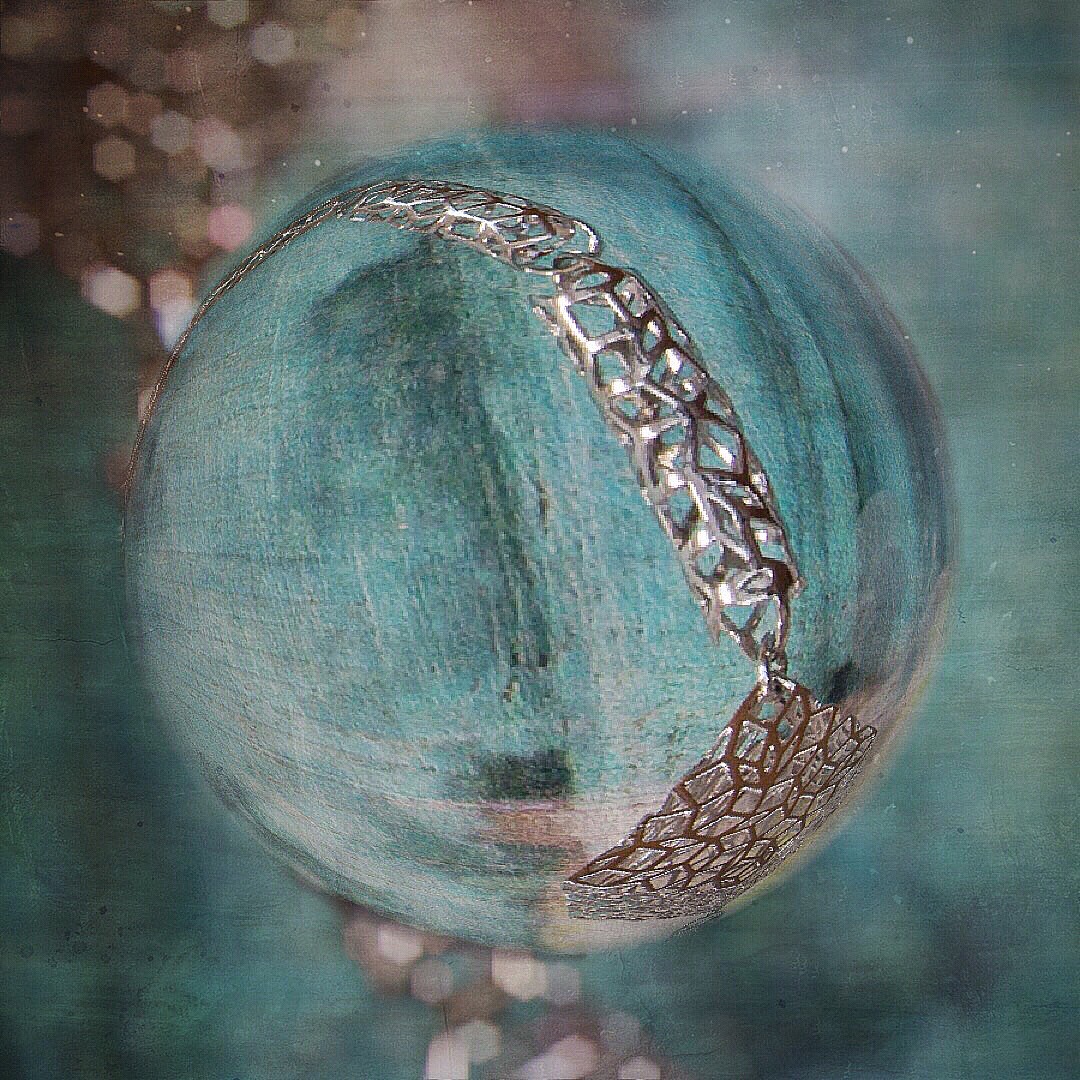
My iphoneography art is an attempt to express these dimensions. Created with apps, the outcome is not fixed at the start of the process. Patient flicking through numerous adaptations of an image I am working on allows me to intuitively choose the one I feel most appropriate. The end image is an expression of the experience of being in cyberspace, as well as an example of being a co-creator with the apps and technology at my disposal.


I look at this world as it looks back at me, and suddenly I am looking as the world.

This looking is accompanied by a deepening sense of responsibility and I am reminded of the question asked by Wisdom 2.0:


“How can we live with greater presence, meaning and mindfulness in the technology age?”


The objective of the conference, @Wisdom2conf, this year, was to address the challenge of our generation: “to not only live connected to one another through technology, but to do so in ways that are beneficial to our own well-being, effective in our work and useful to the world.” I can highly recommend the 2013 videos. (One of my favorites is Jon Kabat-Zinn being interviewed by Melissa Daimler of Twitter).

The technology of this age brings with it the temptation of distraction and addiction when we do not realize the need to be grounded. Checking in with our inner and outward experience regularly and mindfully helps us to maintain this groundedness.


“Without a connection to the earth and to the physical body, all signals become static”. Steven Vedro in “Twitter, Ambient Awareness and Spiritual Practice”.


I share Robb Smith’s opinion. We are no longer in the Information age. We have entered the Transformation age with all the opportunities it offers us to look not at the other through all the perspectives being offered us, but as the other.


Related blog posts:

Digital Archways

Corridorsofcyberspace

Cyberflanerie: Deep Listening in Cyberspace

Thursday
Jan312013

Fog, Mindfulness and Unknowing

January has seen the UAE and many other parts of the world covered in blankets of fog at various intervals. It has affected travel, has had much written about it in the news and has been photographed by many from ground level and up high; all as if it has wanted to gain our attention.


As I was travelling on the metro and looking out at the fog, I recalled a work written by an anonymous mystic in the 14th century, entitled “The Cloud of Unknowing”. The fog certainly depicted an unknowingness and got me thinking about “unknowing”.

When moving within the confines of the fog, the knowledge of where something is has to be suspended for the experience of being acutely conscious of the surroundings one finds oneself in. What is behind one and in front of one is hardly visible. Experiencing the immediate is of paramount importance before one can move forward.

The mind too is so often filled with thoughts of the past and concerns for the future, that the present moment is missed. The fog is a reminder that the present moment is all there is, and as such should be welcomed with non-judgmental awareness. The fog is a reminder to be mindful.

The awareness of the present moment as experienced when being mindful I see as “unknowing”. Becoming aware of that which is incoming through all the senses, experiencing bodily sensations, noticing what one is feeling and thinking, is not a knowing with the mind but an experience of the heart.

In a blog post entitled “In the Fog, Mindfully”, Marguerite Manteau-Rao, @MindDeep, reports on the use of mindfulness meditation, as developed by Jon Kabat-Zinn, with people suffering from Alzheimer’s Disease. One gentleman reports on how it has helped him by saying that,


“Within the daily fog, I can once again find my way, comfortably myself...”


It is easy to confuse objects for something else when moving around in the fog. So too in life, we often mistake our thoughts and opinions for reality. Not taking the time to pause and notice what is actually happening leads to the repeating of old patterns of behaviour. Reacting becomes the order of the day instead of responding to the current situation at hand.

Mindfulness as an “unknowing” is not an attempt to get rid of thoughts. Instead it is a stepping back from them to watch them from an inward spaciousness. At times, with practice, the mind quiets down.

Adjusting one’s way of looking in the fog enable us to see exactly what we need to see at the right moment. Mindfulness or “unknowing” allows us to discover countless opportunities for compassion and kindness not visible to us before.

The fog has something more to share with us. Moving within the fog, (see more pics), it often suddenly parts and we are given glimpses of what is beyond it.


There is also something beyond the fog of the chattering mind.

Jan Birchfield in a recent excellent article in the Huffington post called “Innovation and the Quiet Mind” writes that


“when we quiet the mind through contemplative practices such as meditation, we eventually discover that awareness or consciousness exists beyond it.”


Mindfulness is gaining in popularity as more and more people are realizing that experiencing something fully is far more valuable than mere knowledge about it. We need more and more to “unknow” what before we were convinced was exactly so.

In a world filled with unique problems of the times, knowledge alone will be insufficient when attempting to solve these problems. Innovative ways of being are called for. Where will they be found?


“True innovation, along with any act of creativity, draws from this infinite field of intelligent awareness that exists beyond the mind. This is sometimes called pure awareness.” Jan Birchfield.


In this field of pure awarenes lies realization, innovation and creativity.

The fog is lifting.

Tuesday
Dec112012

Curiosity is key

By nature I love to explore. I can remember being at school and encouraging my friends to join me in discovering exactly what was underneath the stage of the school hall. Waiting until no one was around, we carefully opened the trapdoor, and climbed into the dirt beneath with torches in hand, home-made shields on our knees and masks covering our mouths in case the dust was too severe. Despite the fact that dirt and dust was all that was there, the excitement of the exploration remains in my memory. 

Wandering down alleys and streets, watching people while soaking in the sights, sounds and smells, fills me with joy.  At heart I am a flaneur, a person who walks the city in order to experience it.  

This morning, instead of going on a walk to discover and photograph more skyscrapers in Downtown Dubai, I made my way by metro to visit the souqs in Deira. I have visited this area many times and love to wander up and down the various alleyways known as sikkas. 

As I made my way around the Grand Deira Souq I noticed a sign I had not seen before: Museum of the poet Al Oqaili. Following similar signs I came upon a small museum which still had much construction going on on the outside. I discovered afterwards that the Al Oqaili Museum has only been opened this month.


I was welcomed in and made my way around the restored home of the poet.

 Earlier as I wandered I had tweeted, 

Now on the walls I found a poem written by Al Oqaili about Dubai containing these words:

“Its scent captivated me since I was a little boy.

For it I left all valuable things.”

As I explored the home of the man who had been both a store owner and a poet, and whose work is highly valued in Arabic literature, I had a sense that I was meant to find this place. The poet’s table, his displayed writings, the quiet atmosphere of the courtyard, the teak doors and the restored gypsum ornaments, invited me to reflect again on the creativity that not only lays at the heart of silence, but flourishes when curiosity abounds. 

Al Oqaili had travelled about before settling in Dubai so he must have been curious. 

Recently, Anthony Lawlor tweeted the following:

Further tweets by him read as follows:

Curiosity comes from the root to care. To care about life is to be curious.

Simply being present to what is as it is = a great adventure

Curioser and Curiouser is the natural response to noticing what is actually happening. 

The last tweet reminded me of my blog called “Linda in Wonderland” and made me realize again how much we need to encourage the natural curiosity of small children instead of stifling it.  Melissa Davis, the mother of George Davis, a fellow flaneur (both in the here and in the here2here of cyberspace), writes in an update to Mindfulness and Flanerie

Years ago I read a NYTimes op ed that shared the unscientific findings of a city dweller observing adults accompanying small children around a neighborhood in Manhattan. She reported that the majority of them pushed strollers which ensured timely arrivals wherever the adult was headed. She contrasted them with the handful of adults who walked – meandered – alongside their youngsters, stopping to examine every interesting flower or bit of flotsam along the way. She pointed out that there was nothing more important for a child that age to do than poke along – and through – every curiosity.

Right now we need to foster a generation that will ask questions, search for answers and create solutions.  Unfortunately most of our current school systems merely offer education - the process of receiving or giving systematic instruction, and fail to encourage true learning. 

In a recent Huffington post interview entitled “Mindfulness in the Modern World”, Jon Kabat-Zinn states:

All the interesting stuff is found on the edge between knowing and not knowing.

NASA’s Curiosity rover has landed on Mars. Thirty-five years and 11 billion miles later, Voyager 1 has finally reached the edge of the solar system and will next enter a magnetic highway .

The realms of cyberspace appear to be limitless, and there too we will need to explore with care and curiosity. So fellow cyberflaneurs, not only do we need to listen deeply but our ascent needs to be noted for having at its heart, a deep sense of curiosity.